How Long Does Meal Prep Last in the Fridge? (Food Safety Guide)
How long cooked meal prep keeps in the fridge, based on USDA and FoodSafety.gov guidance, plus cooling, storage, reheating and when to freeze instead.
Disclosure: Product links on this site aren't affiliate links: we don't earn anything from them today. If that changes, we may earn a commission at no extra cost to you, and this note will say so. Parts of this article were drafted with AI assistance and edited before publishing. Read our disclaimer.
Most cooked meal prep keeps for 3 to 4 days in a refrigerator set at 40°F or below. That's the guidance from FoodSafety.gov and the USDA for cooked meat, poultry, soups, stews, pasta dishes and similar leftovers. Anything you won't eat by then should go in the freezer.
"Three to four days" sounds short when you're trying to prep a whole week. But it's the single most important rule in meal prep, and planning around it is easy once you know how. This guide covers the official timelines, why they exist, and the habits that keep food safe from the moment you finish cooking to the moment you reheat it.
This is general guidance for healthy adults. If you're pregnant, older, cooking for young children, or have a weakened immune system, ask your doctor; stricter rules may apply.
The short answer: fridge timelines
These times come from FoodSafety.gov's cold food storage chart. They assume food was handled safely, refrigerated promptly and kept at 40°F or below.
| Food | In the fridge (40°F or below) |
|---|---|
| Cooked meat, poultry and seafood dishes | 3 to 4 days |
| Soups and stews | 3 to 4 days |
| Cooked pasta, rice and grain dishes | 3 to 4 days |
| Casseroles and pizza | 3 to 4 days |
| Egg, chicken, tuna, ham or macaroni salads | 3 to 5 days |
| Hard-cooked eggs | 1 week |
| Raw chicken, turkey and ground meat | 1 to 2 days |
| Raw steaks, chops and roasts | 3 to 5 days |
| Fresh fish (raw) | 1 to 2 days |
For meal prep, the practical rule is simple: count Day 1 as the day you cooked, and plan to finish refrigerated portions by Day 4.
Why 3 to 4 days?
Refrigeration slows bacterial growth but doesn't stop it. Some bacteria, such as Listeria, can grow slowly even at fridge temperatures. After a few days, the risk of food poisoning rises, even if the food still looks and smells fine.
That second point catches people out. The bacteria that make food go bad (spoilage bacteria) are different from the ones that make you ill (pathogens). Pathogens usually don't change the taste, smell or look of food. So the sniff test doesn't tell you whether your Thursday chicken is safe. The calendar does.
If you can't remember when you cooked something, don't taste it to check. Throw it out.
The two-hour rule
The clock on food safety starts when cooking ends, not when food goes in the fridge. Bacteria multiply fastest between 40°F and 140°F, a range often called the "danger zone."
- Refrigerate cooked food within 2 hours.
- If the room or car is above 90°F, that drops to 1 hour.
- Food left out longer than that should be thrown away.
On a busy prep day, it's easy to leave a pot of chili on the stove while you do the dishes and pack everything else. Set a timer when you take each dish off the heat.
How to cool food quickly
You don't need to wait for food to cool on the counter. In fact, you shouldn't. The USDA says hot food can go straight into the fridge. To help it chill evenly:
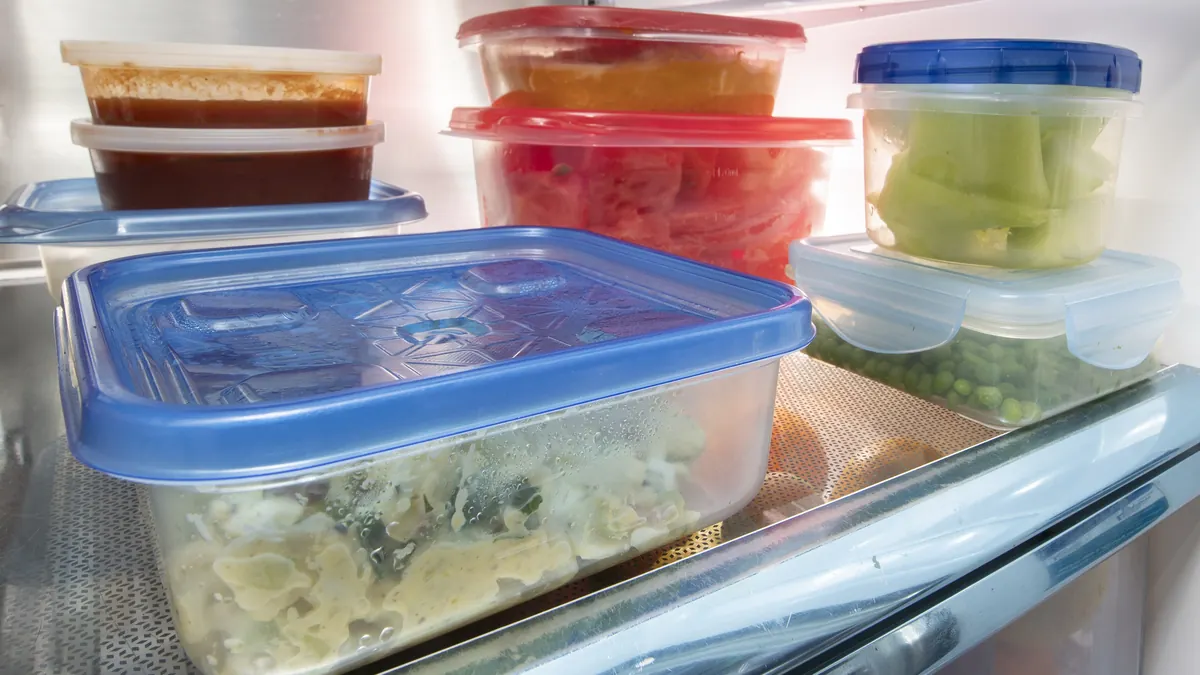
- Divide large batches into smaller, shallow containers. A big, deep pot of soup can stay warm in the center for hours.
- Cut large pieces of meat into smaller portions before chilling.
- Leave space around containers so cold air can circulate.
- Use an ice-water bath for a big pot of soup or stock: set the pot in a sink of ice water and stir for a few minutes before portioning.
Keep your fridge at 40°F or below
Every timeline above assumes a properly cold fridge. Many fridge dials only say "1 to 5" or "colder," which tells you nothing about the actual temperature. An appliance thermometer on the middle shelf is the only way to know.
A few habits help the fridge stay cold:
- Don't overload it. Air needs to move.
- Keep the door closed as much as you can on prep day.
- Store raw meat on the bottom shelf in a container so juices can't drip onto ready-to-eat food.
- The door is the warmest part, so it's better for condiments than for leftovers.
Here's how a Sunday prep fits safely into a working week:
| Day | What to eat | Where it's stored |
|---|---|---|
| Sunday (Day 1) | Cook everything | |
| Monday (Day 2) | Dinner 1 | Fridge |
| Tuesday (Day 3) | Dinner 2 | Fridge |
| Wednesday (Day 4) | Dinner 3 | Fridge |
| Thursday | Dinner 4 | Freezer → move to fridge Wednesday night to thaw |
| Friday | Dinner 5 | Freezer, or cook fresh |
Another option is a mid-week mini prep: cook three dinners on Sunday and two on Wednesday night. It takes about 30 extra minutes and keeps every meal well inside the window.
Reheating safely
Leftovers should be reheated to 165°F, measured with a food thermometer.
- Microwave: Cover the food, stir halfway, and let it stand for a minute or two afterward. Microwaves heat unevenly and the stand time lets heat spread.
- Stovetop: Bring soups, sauces and gravies to a rolling boil.
- Oven: Set it to at least 325°F and cover dishes to keep moisture in.
- Slow cookers aren't recommended for reheating leftovers, because they warm food too slowly.
Only reheat the portion you're going to eat. Don't repeatedly reheat and re-chill the same container.
Does freezing reset the clock?
Freezing pauses it. Food kept at 0°F stays safe indefinitely, though flavor and texture slowly decline. The USDA advises eating leftovers that were thawed in the fridge within 3 to 4 days. The simplest approach is to freeze meals on prep day if you won't eat them within the window, rather than freezing them on day 3 or 4. See freezer-friendly meal prep for what freezes well.
Signs to throw food out immediately
Even within the window, throw food away if it:
- Has visible mold, an off smell or a slimy texture
- Was left out for more than 2 hours (1 hour above 90°F)
- Was in a fridge that lost power for more than 4 hours
Frequently asked questions
How long does cooked chicken meal prep last in the fridge?
Cooked chicken keeps 3 to 4 days in a fridge at 40°F or below, according to FoodSafety.gov. Freeze any portions you won't eat by then.
Can I eat meal prep on day 5?
Official guidance says to eat cooked leftovers within 3 to 4 days. After that, the risk of foodborne illness goes up even if the food seems fine, so it's safest to throw it out or freeze food earlier.
Should I let food cool before putting it in the fridge?
No. Hot food can be refrigerated right away. Divide it into shallow containers so it cools quickly, and get it in the fridge within 2 hours.
Is it safe if it still smells fine?
Not necessarily. Bacteria that cause illness usually don't change how food smells or looks, so go by the date, not the smell.